Binaural Beats: Your Daily Integration Guide for ADHD — Building Calm Focus and Emotional Resilience
Discover how daily use of binaural beats can help manage ADHD symptoms by improving focus, emotional regulation, and mindfulness. This guide explains the science of neuroplasticity, how specific frequencies like SMR, Alpha, Theta, and Delta reshape brain function, and how to integrate them into your daily routine for calm focus and mental resilience.
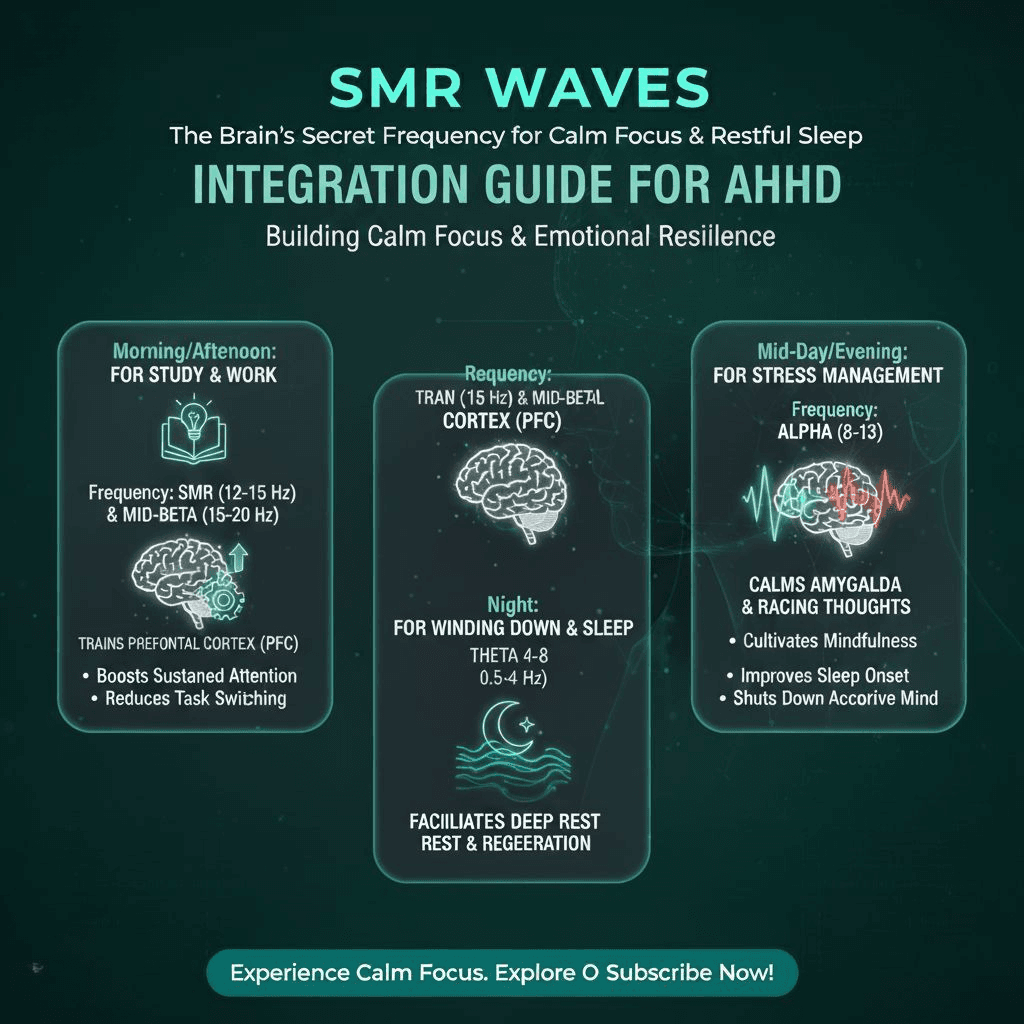
Introduction: The ADHD Challenge of Consistency
For many individuals with Attention Deficit Hyperactivity Disorder (ADHD), the concept of a “daily routine” can feel like an insurmountable hurdle.
Consistency is key, yet it is often the first thing to break down due to executive dysfunction and impulsivity.
However, when it comes to neuro-regulation, consistency is the entire game.
Specialized sound therapy using Binaural Beats offers a surprisingly accessible anchor for building a consistent mental health routine.
By engaging in a daily practice, you are not just listening to music — you are actively participating in the re-training of your brain’s focus and emotional regulation centers.
1. The Scientific Engine: Neuroplasticity and Daily Entrainment
The magic behind the effectiveness of daily binaural beat listening is rooted in Neuroplasticity — the brain’s ability to reorganize itself by forming new neural connections throughout life.
Training the Prefrontal Cortex (PFC)
As explained in our previous guide, the ADHD brain often has a high Theta/SMR ratio, resulting in under-arousal of the Prefrontal Cortex (PFC) — the region responsible for focus and control.
When you consistently listen to SMR-targeted beats (12–15 Hz) daily, you are essentially performing a neuro-workout:
- The Daily Nudge: Each session successfully guides your brain into the calm-focused SMR state (entrainment).
- Strengthening the Pathway: Through repetition, the brain reinforces neural pathways associated with generating the SMR frequency. It learns to access that state more easily on its own, even when the sound is off.
This daily practice turns the “low-fuel” PFC into a more resilient command center, improving not just focus but also long-term cognitive flexibility.
2. Cultivating Detached Observation: The Pathway to Mindfulness
One of the most profound benefits of consistent sound therapy is the development of Mindfulness — the ability to be fully present and acknowledge one’s thoughts and feelings without judgment.
This is vital for the ADHD mind, which often experiences racing, overwhelming thoughts and high levels of internal noise.
Slowing the Thought Train
SMR frequencies promote a state of calm vigilance. This naturally slows the rate of thought generation, creating a cognitive “gap” where none existed before.
The shift is from:
“I am my thoughts and impulses”
to
“I am observing the thoughts and impulses.”
Daily Practice Allows You To:
- Observe Thoughts: By quieting internal chaos, you can step back and view your racing thoughts as data, not commands.
- Release the Urgency: Consistent use teaches your brain that it doesn’t need to react immediately to every stimulus — crucial for reducing impulsivity, a core ADHD symptom.
3. Mastering Emotional and Stress Regulation
The inability to manage strong emotions (known as emotional dysregulation) is a hallmark of ADHD.
This happens because the impulsive emotional center (Amygdala) overpowers the rational decision-making center (PFC).
Building a PFC–Amygdala Bridge
Consistent daily entrainment strengthens the PFC, enabling it to exert top-down control over the Amygdala.
How Daily Practice Helps:
- Reduced Stress Reactivity: Daily listening lowers baseline stress. You become less reactive to small stressors because your regulatory brain region is operating at a calmer capacity.
- Informed Responses: When intense feelings arise, the trained PFC allows you to pause, assess, and choose a thoughtful response instead of reacting impulsively.
4. Your Daily Integration Guide: Where to Start Listening
Building resilience doesn’t require hours — it requires using the right frequency at the right time.
Here’s how to seamlessly integrate your daily binaural beat practice into three key areas of life: focus, stress, and sleep.
A. For Study and Work (Morning/Afternoon)
- Goal: Boost sustained attention and reduce task-switching.
- Frequency: SMR (12–15 Hz) or Mid-Beta (15–20 Hz).
- How to Use: Start the track 5 minutes before a demanding task (e.g., studying or writing). Listen for the first 30 minutes. Avoid using it for passive activities like TV — keep it associated with deep focus.
B. For Stress Management (Mid-day/Evening)
- Goal: Rapidly shift out of an anxious or overwhelmed state (Amygdala response).
- Frequency: Alpha (8–13 Hz).
- How to Use: When stress hits, take a 10-minute break. Close your eyes and listen to Alpha tracks. This encourages relaxed vigilance and re-engages the rational mind.
C. For Winding Down and Sleep (Night)
- Goal: Quiet the racing mind and improve sleep onset.
- Frequency: Theta (4–8 Hz) or Delta (0.5–4 Hz).
- How to Use: Use Theta tracks during your bedtime routine (reading, journaling) to transition the mind. Switch to Delta tracks once in bed for deep restorative sleep.
By making this small, specialized sound session a daily commitment, you’re investing in long-term neuro-regulation, transforming your relationship with your mind, and moving toward a calmer, more focused life.
Start your journey toward greater resilience today.
Our monthly subscription provides fresh, scientifically curated SMR, Alpha, Theta, and Delta tracks — ensuring your brain constantly receives novel stimulus for optimal neuroplastic development.