Pink Noise: The Deep Sleep Frequency
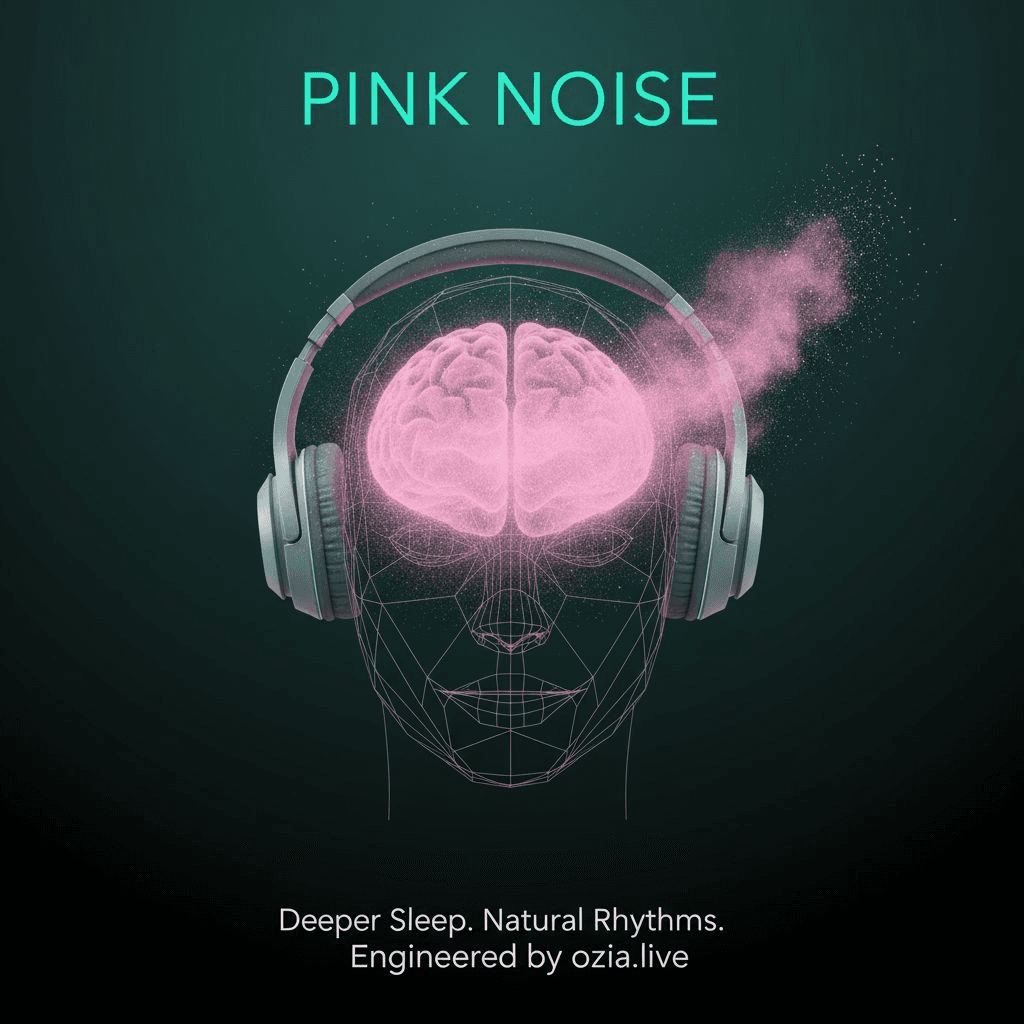
This guide explores the unique spectral properties of Pink Noise, its profound impact on your brain during sleep, and the critical need for precision engineering when combining it with active brainwave entrainment techniques like Binaural Beats. Understanding this science is key to appreciating the specialized content offered by ozia.
Introduction: The Sound That Mimics Nature
While White Noise is known for its effectiveness in masking distractions, Pink Noise is the scientifically preferred sound for improving the quality and depth of sleep.
Unlike White Noise, which is often described as a harsh hiss, Pink Noise is softer, lower-pitched, and often compared to the gentle, rhythmic sounds found in nature—steady rainfall, the rustling of leaves, or a distant waterfall.
This guide explores the groundbreaking science of Pink Noise and highlights why ozia.live offers the only precision-engineered solution for maximum cognitive and restorative benefit.
Defining Pink Noise: The Science of the 1/f Spectrum
Pink Noise is defined by its energy distribution—the power of the sound decreases proportionally as the frequency increases. This relationship follows a mathematical pattern known as the 1/f frequency (or 1/f decay).
The 1/f Law and Natural Harmony
The 1/f frequency distribution is abundant in natural and biological systems, governing countless natural rhythms:
- The Human Heartbeat: Time intervals between heartbeats follow a 1/f pattern.
- Brainwaves: The brain’s electrical activity exhibits a 1/f decay structure.
- Astronomy: Light emitted by distant stars and galaxies often follows this same rule.
This correlation with natural rhythms explains why the brain finds Pink Noise so pleasing and stabilizing. By mimicking the consistent patterns found in healthy biological systems, Pink Noise encourages the brain to stabilize its own rhythms, resulting in deep calm and balanced neural activity.
Spectral Comparison: Pink vs. White Noise
| Noise Color | Energy Distribution | Perceived Sound | |------------------|------------------------|----------------------| | White Noise | Equal intensity across all frequencies. | Harsh, static, high-frequency hiss. | | Pink Noise | Energy decreases as frequency rises (1/f decay). | Softer, deeper, like rainfall or ocean waves. |
Pink Noise and Sleep: The Delta Wave Connection
The most significant scientific application of Pink Noise lies in its ability to enhance Slow-Wave Sleep (SWS) — the deepest, most restorative phase of sleep dominated by Delta Waves (0.5–4 Hz).
The Enhancement of Slow Oscillations
Research shows that playing Pink Noise in sync with the brain’s Delta oscillations can amplify the amplitude and stability of those waves.
- Sleep Spindles: Pink Noise enhances the occurrence and quality of sleep spindles—short bursts of activity that play a vital role in memory consolidation.
- Memory Consolidation: Since SWS is essential for transferring new memories from the hippocampus to the cortex, Pink Noise’s deep synchronization directly boosts memory and cognitive recovery.
Improved Psychological Metrics
Beyond measurable brain activity, Pink Noise also enhances subjective experiences:
- Reduced Sleep Latency: People fall asleep faster and stay asleep longer.
- Better Rest: Users report feeling more rested, alert, and emotionally balanced the following day.
The Power of Synergy: Pink Noise and Binaural Beats
While Pink Noise passively supports natural neural rhythms, combining it with Binaural Beats (BB)—which actively guide the brain’s electrical activity—creates an extremely powerful synergy.
The Scientific Rationale for Combination
Together, the two form the perfect environment for restorative sleep:
- Pink Noise (Foundation): A stable acoustic base that enhances Delta Waves and masks external noise.
- Delta Binaural Beats (Accelerator): Actively guides the brain toward deep Delta frequencies (around 1 Hz), accelerating entry into the deepest sleep states.
The Acoustic Engineering Challenge
Successfully combining a full-spectrum sound like Pink Noise with delicate carrier frequencies of Binaural Beats requires high-precision acoustic engineering.
Risk of Destructive Interference
If the Pink Noise is poorly mixed or filtered, it can interfere with the frequencies that make Binaural Beats effective:
- Destructive Overlap: Poorly balanced Pink Noise may drown out or distort the Binaural Beat’s carrier tones.
- Signal Neutralization: This interference can render the neural entrainment ineffective, leaving only flat, noisy sound rather than a targeted cognitive effect.
The ozia.live Commitment: Engineered for Deeper Sleep
A subscription to ozia.live is an investment in neurological precision. Each Pink Noise track is engineered to support your brain’s natural sleep architecture while avoiding acoustic interference with active brainwave entrainment.
Our Engineering Standards
- Precision Filtering: Proprietary algorithms shape the 1/f decay curve to deliver optimal slow-wave enhancement without interfering with the Binaural Beat carrier tones.
- Seamless Integration: Each Pink Noise layer is calibrated to serve as a stable base, ensuring Binaural Beats maintain full clarity and power.
- High-Fidelity Purity: All recordings are mastered to eliminate artifacts, guaranteeing clear, balanced sound that supports genuine neural entrainment.
Conclusion
Pink Noise is more than just a soothing background—it’s a biological ally for deep sleep and memory consolidation.
When precisely engineered and paired with Delta-range Binaural Beats, it becomes a powerful tool for promoting restorative rest, emotional balance, and cognitive recovery.
Ready to achieve restorative, 1/f-enhanced sleep?
Explore the ozia.live Deep Sleep & Restoration collection — featuring expertly engineered Pink Noise and Delta Beats designed to guide your brain toward its most rejuvenating rhythm.